
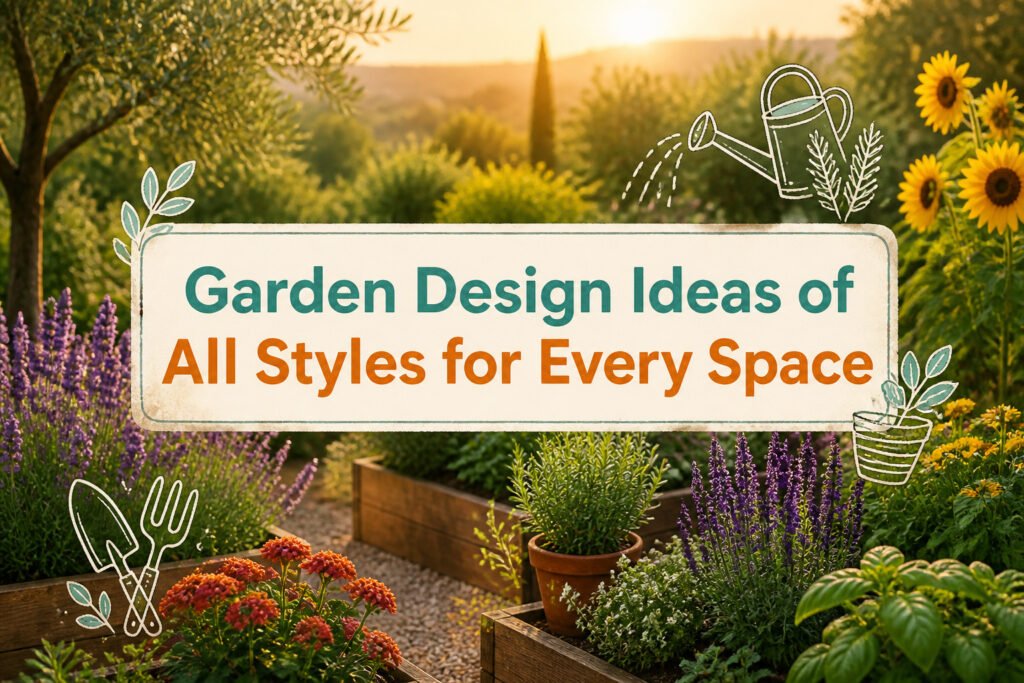
The right garden design idea depends on how much of your climate you are willing to fight. A Mediterranean palette shrinks your water bill where summers bake, but lavender sulks through humid nights and will not forgive the mismatch. I learned that gravel between raised beds was not decorative at all; the drainage it provided during a wet spring saved rosemary from rot.
1. Japanese Gardens

A Japanese garden builds its calm from restraint. Water moves slowly, if at all; a koi pond carries the sound and the flash of color, but the surrounding stone stays still. Raked sand or gravel stands in for rivers, the lines drawn with a bamboo rake and redone after rain. Stone lanterns mark paths or sit alone as focal points, their weathering part of the point. Plants are chosen for texture over bloom: moss, bamboo, Japanese maple, shrubs pruned into domes. Nothing crowds anything else.
The style traces back to around 1300 AD, when Zen Buddhism spread and gardens were built for spiritual entry rather than physical ones. That history still shapes the choices. A stone lantern placed without thought breaks the mood; one set where it catches dawn light earns its spot. The maintenance is ongoing, the raking, the pruning, the clearing of fallen leaves from water. The payoff is a space that asks nothing of you but to stay quiet in it.
2. Modern Gardens

A modern garden reads as calm because everything in it earns its place. Clean lines and geometric layouts carry the eye without competing for it, and ornamentation stays minimal enough that a single sculptural plant or concrete plane can register as the focal point it is meant to be. I keep coming back to hardscaping for the actual structure: concrete, metal, and lighter woods set the cooler tones that define these spaces, and they do the practical work of reducing what you have to maintain once the layout is set.
The plant palette stays intentionally small. Repeating agave, grasses, or textural shrubs like White Sage in a pattern beats mixing dozens of varieties; the repetition is what makes the space feel deliberate rather than sparse. A neutral color scheme in both materials and plant selection lets the forms themselves do the visual work. Furniture should follow the same rule, simple pieces that echo the clean lines already established rather than introducing new shapes to parse. The result reads as an extension of the house because it shares the same restraint; the garden does not try to be a separate room with its own competing logic.
3. Mediterranean Gardens

A Mediterranean garden runs on the assumption that water is scarce and sun is not. Drought-tolerant plants with silver-gray foliage reflect heat instead of absorbing it, which is why olive trees, lavender, and rosemary show up in nearly every version of this style. The olive tree in particular carries that silvery leaf and a structural presence that needs almost no irrigation once it settles in.
Terracotta pots, gravel paths, and rough stone walls do more than look rustic. They store and release heat slowly, buffering the temperature swings that stress plants. I tried gravel between raised beds once thinking it was purely decorative; the drainage it provided during a wet spring saved the rosemary from rot.
Fragrance is not incidental here. Lavender hedged along a walkway releases oil when brush passes it. Rosemary does the same. In a small courtyard or on a balcony, that concentration of scent is the whole point, and it costs nothing extra beyond the initial plants.
This style suits dry climates honestly. Where summer water restrictions arrive every July, a Mediterranean planting palette shrinks the bill and the guilt at the same time. The tradeoff is patience: lavender established in year one barely needs you by year three, but it sulks through wet soil and humid nights. If your summers are muggy, this is not the garden that forgives you.
4. English Gardens

English gardens pull you in with symmetry that still manages to feel alive. The formal bones are unmistakable: clipped boxwood hedges, gravel paths laid in straight lines, geometric beds that repeat left to right. What saves it from stiffness is the planting. Sources describe this as the cottage style’s looser cousin, where roses, peonies, tulips, and delphiniums spill over their edges in deliberate waves of color.
The paths matter. Winding brick or roughened cobbles curve away from those straight axes, letting you wander rather than march. Fountains or classical urns sit at center points, but the seasonal progression does the real work of keeping the garden in motion. Spring tulips give way to summer delphiniums and roses, then late-season color carries through until the structure alone carries winter.
For a small yard or patio, the lesson is picking one axis and one focal point rather than trying to replicate estate scale. A single straight path with a small urn at its end, borders planted densely with a limited palette of whites and pale blues like hydrangea, keeps the feel without the maintenance burden. Let the shrubs grow naturally rather than shearing them into topiary; the passages note this saves work and the relaxed shape reads more domestic anyway.
5. Tropical Gardens

Tropical gardens run on leaves large enough to cast their own shade. Elephant ears, bananas, and hibiscus build the look: broad surfaces in deep green, with color coming from occasional eruptions of red or orange bloom rather than from scattered flowers. The style reads as dense and vertical; palms or bird of paradise stretch upward, while lower layers fill the gaps until almost no ground shows. That layering is what lets a tropical garden read as lush even on a small patio or balcony, where a single corner done this way becomes the whole view.
Water matters. Many of these species evolved beneath tree canopies in wet climates, so they tolerate shade but expect consistent moisture. In drier zones, the look still works with drought-tolerant substitutions: certain palms, pineapple guava, red hot pokers, or bougainvillea can carry the same bold form through dry spells without the same irrigation demand. The choice is between matching the climate or matching the maintenance; both routes reach the same visual density, but one asks far less of a hose.
6. Desert Gardens

Drought-resistant plants and gravel form the backbone of a style that asks almost nothing of you once it is established. Succulents, cacti, and agaves store their own water and shrug off heat that would crisp a lawn in July. Aim for two-foot decorative boulders placed individually between groupings, giving each sculptural plant room to read as an accent rather than cluttering them together.
Gravel does the work mulch does elsewhere: tan decomposed granite or pea gravel suppresses weeds, drains fast, and never needs replacing. The open rhythm of planting, then open space, then planting again matters more here than in other styles; too stuffed and the spare beauty collapses into busy. Sedum mats can soften the gaps if bare gravel feels severe.
Water use drops dramatically, which is the point. These plants thrive on neglect, and the look holds through seasons that punish traditional beds. Even outside the Southwest, a scaled version of this palette survives where summer drought has become the norm rather than the exception.
7. Cottage Gardens

A cottage garden reads as the memory of a place rather than a plan on paper. The style carries over from 18th-century England, where peasants filled every usable scrap around their homes with vegetables, medicinal herbs, and whatever flowers self-seeded between. What started from necessity became idealized by the leisurely class, and the modern version keeps that same spirit: heavy planting with almost no open ground, paths of stone or gravel that curve without geometry, and plants spilling over edges as if no one told them where to stop.
The plant list is where personality shows. Foxgloves and hollyhocks give vertical lift, climbing roses scramble over fences or walls, and the whole thing mixes ornamentals with edibles in a way that would make a formal designer wince. Let plants self-seed and the garden starts editing itself, though the editing is slow and the gardener still has to pull what turns thuggish. The effect is romantic, slightly unkempt, and deliberately rule-breaking. Furniture, if you add it, works best weather-beaten and tucked under something that canopies overhead.
8. Eco-Friendly Gardens

A rain garden set six inches below the surrounding grade turned the wettest corner of my yard from a mud patch into the busiest pollinator stop on the block. The technique is simple: excavate a shallow bowl where water already gathers, backfill with compost and a sand-soil mix, and plant with species that tolerate both brief flooding and dry spells. Coneflowers, milkweed, and black-eyed Susans handle this swing in most regions, while native grasses like switchgrass hold the slope and give structure through winter.
The real savings come from what you stop doing. Once established, these plantings need no fertilizer, no supplemental water, and no spraying. The deep roots of prairie-style natives build soil structure year after year, pulling carbon down and opening channels for water to infiltrate rather than run off. A friend who installed a 200-square-foot pollinator bed on her hellstrip saw her water bill drop by roughly thirty percent the following summer, though the bigger shift was the time she got back: two mowings replaced by one spring cutback of the standing stems.
Rain gardens and pollinator strips work at patio scale too. A downspout planter or a narrow channel of pea gravel directing roof water into a planted basin captures the same principle. Lavender, salvias, and rosemary suit the drier edges of these installations in warmer zones, offering the soft, warm look of West Coast gardens without the coastal climate requirement.
9. Coastal Gardens

Salt-tolerant plants are the only ones that survive long enough to matter in a coastal garden. Sea thrift, beach grass, and rugosa roses handle the salt spray and sandy soil that kill off less hardy choices within a season or two. I learned this the hard way after watching lavender and hydrangeas struggle where the breeze carried too much grit and sodium.
Wind breaks the layout before anything else. A solid fence catches gusts and topples; a porous screen of hardy shrubs or ornamental grasses slows the air without creating turbulence. Driftwood, weathered wood, and gravel hardscaping echo the shore without fighting it. Pebbles or seashell mulch drain fast and stay put when sand would blow away.
The soil itself needs accepting, not fixing. Sandy ground drains too quickly for thirsty plants, so succulents and rosemary fit where hostas would starve. The relaxed, breezy feeling comes from working with these limits rather than against them: billowy textures, casual lines, and materials that already look weathered.
10. Wildlife Gardens

A wildlife garden asks less about what looks pretty to us and more about what keeps a local ecosystem running. I started mine after watching a single finch ignore every blooming perennial I owned and dive straight into a patch of weedy native aster. That was the lesson: native plants and local wildlife evolved together, and the birds know the difference even when we do not.
The design builds in three layers, the same way wild edges do. Trees and tall shrubs give height, mid-size shrubs fill the middle, and low understory plants complete the ground cover. Each layer houses different animals; a ground beetle needs different cover than a canopy-feeding warbler, and a garden that stacks all three keeps both.
Food has to last past the first flush of summer. Flowers loaded with pollen and nectar feed insects through the growing season, then fruits and berries that persist into winter carry birds through the cold months. A shallow water source, even something as simple as a bird bath, draws more species than food alone. I learned that the hard way after two dry years when my berry-heavy plot sat nearly empty.
The overlap with eco-friendly gardening is real, but the focus shifts. An eco-friendly garden might lead with reduced water use or organic practice; a wildlife garden starts with habitat and lets the beauty follow. Letting plants self-seed and spread, keeping dead stems standing through winter, and leaving leaf litter in place all read as mess to a tidy eye, but they read as shelter to a queen bee looking for a nesting cavity.
Bat boxes, bug hotels, or a simple brush pile add targeted shelter if you want to pull in specific visitors. The garden grows into something that sustains itself with minimal intervention, which is the point: you are building a system, not maintaining a display.
Design Elements That Tie Styles Together

A path does more than keep your shoes clean. In a meadow-style planting, a curved, informal walkway mirrors the flowing grasses and open sightlines, while the same material laid dead straight reads as modern farmhouse. Gravel or stone underfoot works in both places. The difference is the line you cut.
Water features operate the same way. A traditional stone fountain signals one style, matte black fixtures another. Corten planters or galvanized metal do the same heavy lifting. The object itself does not lock you into a look; it is how the surrounding elements agree with it.
Plant choice tightens or loosens that agreement. Native grasses, coneflowers, and milkweed carry a prairie garden without any signage needed. Hydrangeas, lavender, and a row of raised edibles tilt the same yard toward farmhouse. The pollinator value stays. The mood changes.
What convinced me, reading through a dozen of these, is that style is a team effort. A single Japanese rain chain or French lavender hedge does not create the look. It is the repetition across pathways, water, and plantings that makes a visitor know where she stands before she names it.
Plant Selection by Climate and Style

A modern or contemporary garden with its clean lines and ornamental grasses will ask for shears a couple times a season to keep those edges crisp. The grasses read as low-effort from a distance, but the visual discipline costs something in maintenance. A naturalistic garden flips that contract: it can look untended while actually needing deep weeding a few times a year to stop invasives from swallowing the whole planting. Neither style is truly hands-off; they just spend the labor differently.
Climate narrows the field before aesthetics even enter. Xeriscape design leans on permeable gravel or mulch paired with native or climate-adapted plants that survive on rainfall alone once established. The palette stays neutral, the irrigation disappears, and the style suits almost any house type without fighting its architecture. In hotter zones, this is often the sustainable default, not a stylistic compromise.
Hardiness zone should be your first filter, not your last. A plant that survives your winter but needs summer water you cannot give will die as surely as one frozen out of zone. Match the plant to the actual stressor: drought tolerance where summers bake, humidity resistance where air sits wet, cold hardiness where the thermometer drops hard. The style you want, cottage or minimal or somewhere between, only works if the plant list was filtered through what that specific yard will actually allow.
Sustainable Practices Across Styles

Sustainable ideas run through nearly every style worth planting in 2026, and the thread that ties them together is working with what already belongs in your yard. Native plants are the clearest starting point. A southwestern layout leans on cactus, succulents, and drought-tolerant shrubs because they survive the dry heat without the water bill that kills a lawn. Meadow designs push further in the same direction: wildflower fields built from extremely local species that shift color from spring through autumn seed heads and need almost no intervention once established.
Rainwater harvesting fits anywhere the roof drips. Even a simple chain of copper rings or terracotta pots guiding gutter runoff into a barrel turns a necessary function into something worth looking at. Gravel and boulder ground cover, borrowed from desert xeriscaping, cuts evaporation and weeds across styles from modern to cottage. The sustainable choice is rarely a separate look; it is the base layer that makes the rest of the design cheaper to keep alive.
Layout and Structure Basics

Raised beds changed how I think about starting a garden, mostly because my first in-ground attempt collapsed into a weedy rectangle I avoided looking at. Framing soil even a foot above grade gives you control over drainage and composition, and the clean edges force a layout that looks intentional whether you build from cedar, galvanized steel, or the corten that rusts to a dark bronze over a season. Gravel paths between beds keep mud off your knees and make the geometry readable from a window.
Vertical gardening is where small spaces stop feeling small. A north-facing wall that grew nothing but moss in my old yard carried climbing hydrangea within two summers; the leaves filled the plane and the lace-cap flowers came after. Clematis and jasmine want the sun, but ivy and chocolate vine will cover a shady boundary fast enough to make the garden feel deeper than it is. The trick is matching the climber to the exposure, not forcing a sun-lover into shade and wondering why it stalls at three feet.
The hardscaping needs to earn its keep. Every path, bed frame, or trellis should do something a plant cannot do alone: carry your weight through wet weather, hold soil where it would wash, or lift growth to eye level. I keep structural planting, the permanent stuff like birch or clipped evergreen, to about a third of the visual weight. Less and the garden looks soft and unfinished in winter; more and you are maintaining a display of twigs and waiting for leaves to humanize it. The balance tilts toward structure in small gardens, where a single shaped shrub or small tree gives year-round form that borders alone cannot manage.
Frequently Asked Questions
What are the different types of garden styles?
The main garden styles covered are Japanese, modern, Mediterranean, English, tropical, desert, cottage, eco-friendly, coastal, and wildlife gardens. Each has distinct plant palettes, hardscaping materials, and maintenance demands. Japanese gardens favor restraint and raked gravel; cottage gardens pack in self-seeding flowers and edibles with almost no open ground.
How do I choose the right plants for my garden style?
Start with your hardiness zone and actual stressors, not just winter cold. A plant that survives your zone but needs summer water you cannot provide will die as surely as one frozen out. Match drought tolerance to baking summers, humidity resistance to wet air, and cold hardiness to hard freezes, then filter for the aesthetic you want.
What are the key elements of a successful garden design?
Pathways, water features, plant selection, and the balance between hardscaping and planting carry every style. A curved gravel path reads informal and flowing; the same material laid straight signals modern restraint. The repetition across these elements, not any single object, tells a visitor what kind of garden she has entered before she names it.